How Big Is a 30L Backpack | The Real Specs You Need
This post contains affiliate links. As an Amazon Associate, we earn from qualifying purchases.
A 30-liter backpack holds 1831 cubic inches of theoretical volume, but its real-world size is defined by its physical dimensions, height, width, and depth, which vary wildly by brand. For example, the Thule EnRoute is 19.3″ tall, the Osprey Skarab is 21″ tall, and the Grayl Mission EXP is 21″ tall but much wider. The “30L” label tells you nothing about whether it will fit under an airplane seat or on your back.
That number is a manufacturer’s estimate, not a ruler. They get it by filling every pocket with plastic pellets and measuring the displaced volume. Your packing cubes, jacket, and laptop don’t behave like pellets. A bag’s shape and panel design change how much you can practically carry.
What follows: the exact specs from three top brands, a decoder for airline size rules, and how to measure your own torso so the pack doesn’t hurt you by mile two.
Key Takeaways
- Ignore the “30L” label when judging physical size. Always check the manufacturer’s listed dimensions in inches or centimeters.
- A 30L backpack is not a standard size. The Osprey Skarab 30 (21″h x 11″w x 10″d) and the Thule EnRoute 30L (19.3″h x 11.4″w x 11″d) have the same volume but completely different shapes.
- Airline sizer bins measure rigid external dimensions. A pack that’s 22″ tall but soft-sided might squeeze in; one that’s 19″ tall but overstuffed to 10″ deep might not.
- Your torso length, not your height, decides if a backpack fits. A pack too long for your torso will ride on your hips, causing shoulder strain within an hour.
- For most day hikes, urban travel, and as a personal item, a 30-liter backpack is the sweet spot. For multi-day trekking with a sleeping bag, consider a 35-liter backpack.
What Are the Actual Dimensions of a 30L Backpack?
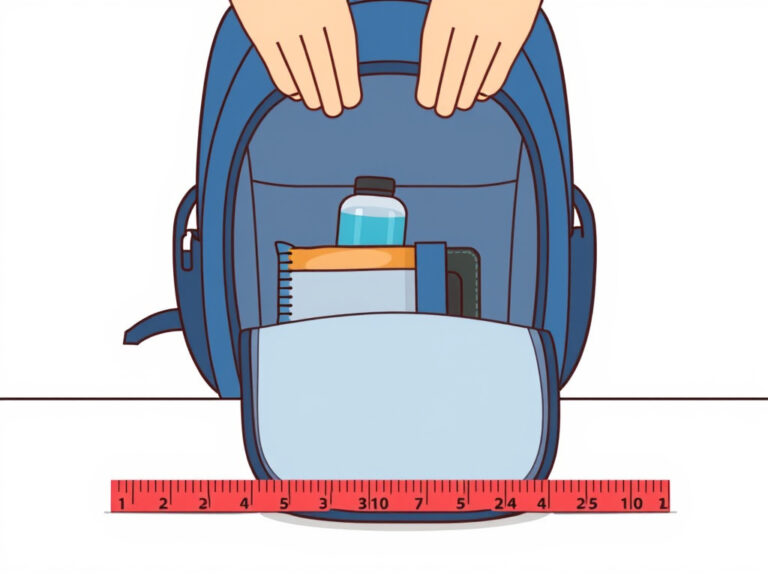
The numbers on a spec sheet are the only truth you get. The “30L” is a marketing convenience, a rounded-off figure for a complex measurement. The real constraints are the three numbers listed next: Height x Width x Depth.
Before you start: When comparing backpacks, you are comparing rectangles. A tall, narrow 30L pack carries differently than a short, deep 30L pack. The tall pack may fit a sleeping bag vertically but won’t slide under an airplane seat. The short pack might be perfect for under-seat storage but will force you to pack in layers, not bundles.
Here are the real dimensions from three different 30L packs, pulled directly from their official specification sheets.
| Backpack Model | Dimensions (H x W x D) | Key Shape Note |
|---|---|---|
| Thule EnRoute Backpack 30L | 19.3 x 11.4 x 11.0 in | Nearly square profile. Depth (11″) is almost equal to height. |
| Osprey Skarab 30 | 21 x 11 x 10 in | Classic tall, narrow hiking profile. Maximizes vertical space. |
| Grayl Mission EXP 30L | 21 x 13 x 10 in | Wider than most. The 13″ width accommodates a 17″ laptop sleeve side-entry. |
The Thule EnRoute and the Osprey Skarab both claim 30 liters (1831 cu in). The Thule is two inches shorter but an inch deeper. The Osprey is taller and narrower. They will not fit the same spaces.
The Grayl Mission EXP is also 30L, but its 13-inch width is a full two inches wider than the Osprey. This extra width makes it fantastic for organizing gear in the main compartment but can make it feel bulky on a narrow torso.
The part nobody mentions: These are external dimensions. Internal dimensions are always smaller. The Thule EnRoute 30L’s internal dimensions are listed as 15.2 x 10.4 x 1.2 in, that 1.2-inch depth is for a specific laptop compartment, not the main cavity. The main compartment is larger, but you see the point: the outside shell takes up space.
Why “30 Liters” Is a Useless Measurement for Size
Liters measure volume. Airline bins and your back measure physical space. The conversion is flawed because backpacks are not perfect cubes.
Manufacturers calculate volume by the ASTM F2153 standard or similar: they fill the main compartment and every closeable pocket with 20mm plastic balls, then pour those balls into a graduated cylinder. It’s a theoretical maximum. You will never pack your bag with tiny, uniform spheres.
A backpack’s capacity rating is its potential, not its promise. You might only get 28 liters of practical, accessible space out of a “30L” bag because of rigid frames, curved panels, and organizational pockets that eat into the main cavity.
This is why a 25-liter backpack from one brand can sometimes feel roomier than a competitor’s 30L model. The design efficiency, how much of the theoretical volume is actually usable for your gear, matters more than the number on the tag.
Where this goes sideways: You buy a 30L backpack for a budget airline’s strict “personal item” dimensions (often around 18x14x8 inches). Your backpack’s spec sheet says it’s 19 inches tall. You think, “It’s close, it’ll squeeze.” But the bag’s depth is 10 inches. When you pack it for a trip, that depth bulges to 12 inches. At the gate, your bag won’t slide into the metal sizer bin. You pay a checked bag fee that costs more than the flight. The liter capacity told you nothing about that hard bin.
How to Match a 30L Backpack to Your Body
A backpack that doesn’t fit your torso is a pain machine. The load transfers poorly, the straps dig, and you’ll be adjusting it every ten minutes. Your torso length, the distance from the bony bump at the base of your neck (C7 vertebra) to the top of your hip bones (iliac crest), is the critical number.
Common mistake: Choosing a backpack based on your height. A tall person can have a short torso; a shorter person can have a long torso. The only way to know is to measure.
Here’s how to measure your torso length:
- Have a friend stand behind you.
- Tilt your head forward. Find the prominent bony vertebra at the base of your neck. This is the C7.
- Place your hands on your hips, fingers pointing forward. Your thumbs will rest on the back of your hip bones, the iliac crest.
- Have your friend measure the distance between the C7 vertebra and an imaginary line between your two thumbs.
- That number, in inches or centimeters, is your torso length.
Most 30L backpacks come in a “one-size” range, like 17-22 inches. The Osprey Skarab 30 fits torsos 17-22″. If your torso is 16 inches, this pack will be too long. The harness will sit too low, and the hip belt will ride on your stomach, not your hips.
If you’re between sizes or have a particularly short or long torso, look for brands that offer multiple sizes. Some technical hiking packs in the 30L range, like the Deuter Guide 30, offer specific torso adjustments.
30L Backpack vs. Other Common Sizes
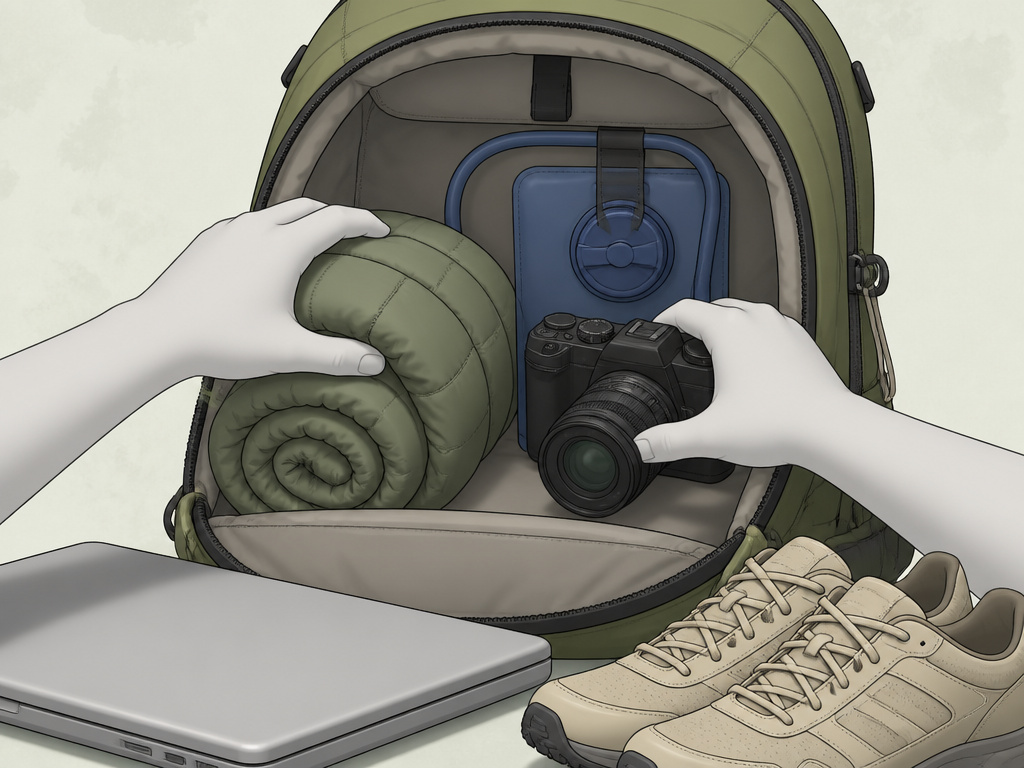
Is 30 liters the right size for you? That depends on what you’re leaving behind. This isn’t about gear lists; it’s about volume relativity.
| Backpack Size | Best For | Will It Fit? |
|---|---|---|
| 20L Backpack | Daily commute, minimalist day hike, small laptop. | Lunch, light jacket, 13″ laptop, notebook. |
| 30L Backpack | Full-day hike, weekend urban trip, gym + work gear. | 3L water bladder, rain shell, first-aid kit, lunch, camera. Plus a laptop and shoes. |
| 40L Backpack | 2-3 day trek with lightweight shelter, travel as a sole carry-on bag. | Sleeping bag, pad, tent, stove, food, plus clothing layers. |
| 50L Backpack | Week-long backpacking trips, extended travel. | All the 40L gear, plus more food, fuel, and spare clothing. |
A 20-liter backpack is for essentials. A 40-liter backpack is for systems. The 30L sits in the middle: it’s for essentials plus a few systems. You can carry a hydration reservoir, a puffy jacket, and a tech kit. You cannot carry a sleeping bag and a tent without strapping them to the outside.
For a deep dive on the next size up, see our comparison of a 35-liter backpack. The 5-liter jump is often the difference between “tight fit” and “comfortable margin.”
Will a 30L Backpack Fit Airline Carry-On Rules?
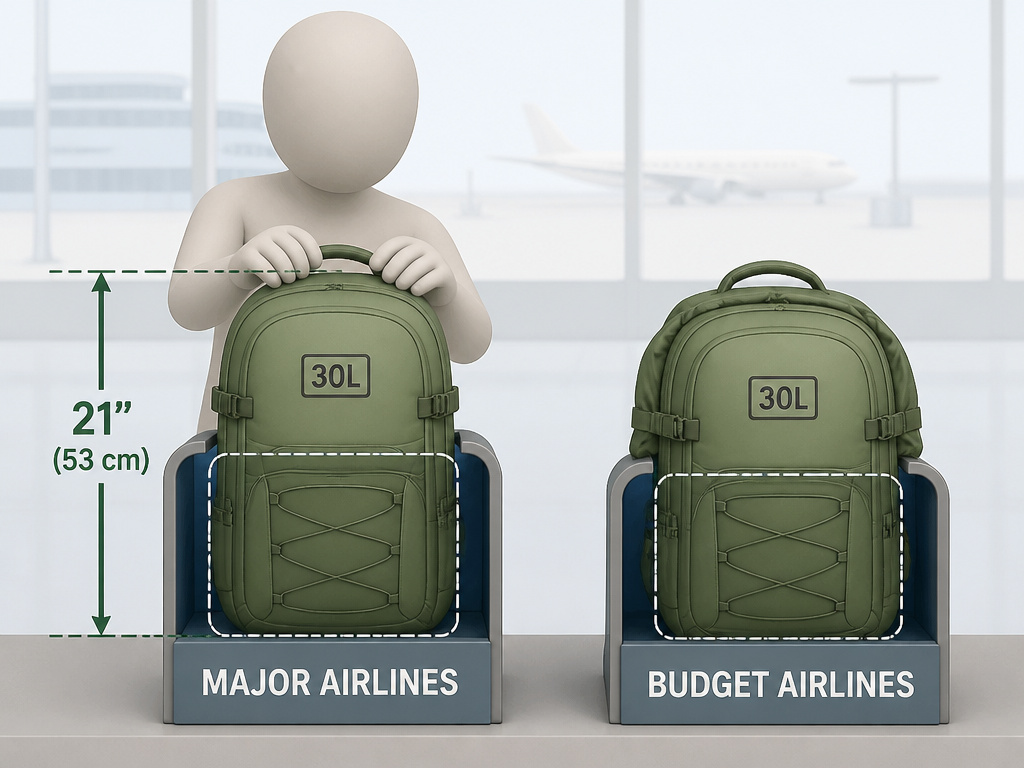
This is the million-dollar question. The answer is: maybe, but you must check the dimensions, not the capacity.
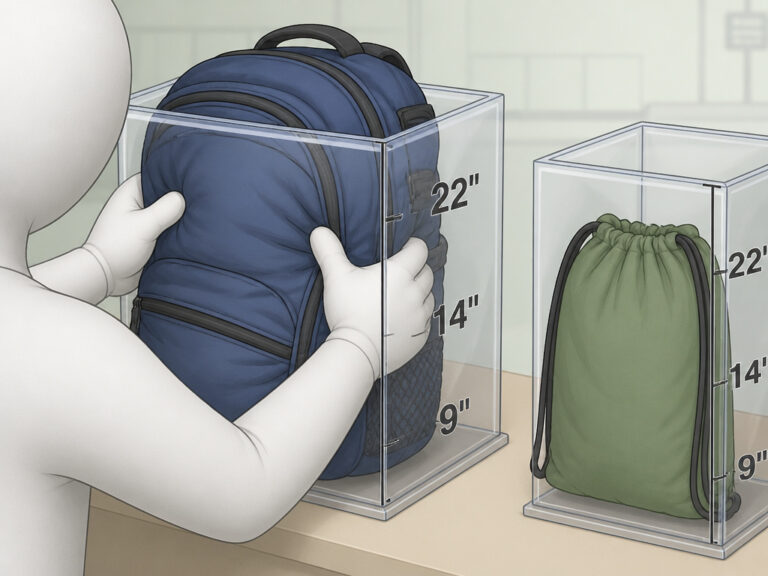
Most major U.S. Airlines (Delta, American, United) have a carry-on size limit around 22 x 14 x 9 inches. Many 30L backpacks, like the Osprey Skarab at 21 inches tall, are designed to sneak under this limit.
Easy to miss: The “sizer bin” at the gate is a rigid box. A soft-sided backpack can often be compressed by an inch or two to fit. The risk isn’t the bag’s stated size, it’s how you pack it. An overstuffed front pocket can add two inches of depth and get you flagged.
Budget airlines (Spirit, Frontier, Ryanair) are stricter. Their “personal item” dimensions are often as small as 18 x 14 x 8 inches. Very few 30L packs will meet this without being half-empty. For these airlines, a 22-liter backpack or 26-liter backpack is a safer bet for under-seat storage.
If you need to check a backpack on a flight, a 30L bag is robust enough to handle it, especially if it has a internal framesheet for structure. Use the pack’s own compression straps to slim its profile and reduce the chance of straps getting caught on conveyor belts.
Choosing Your 30L Backpack: A Reality Check
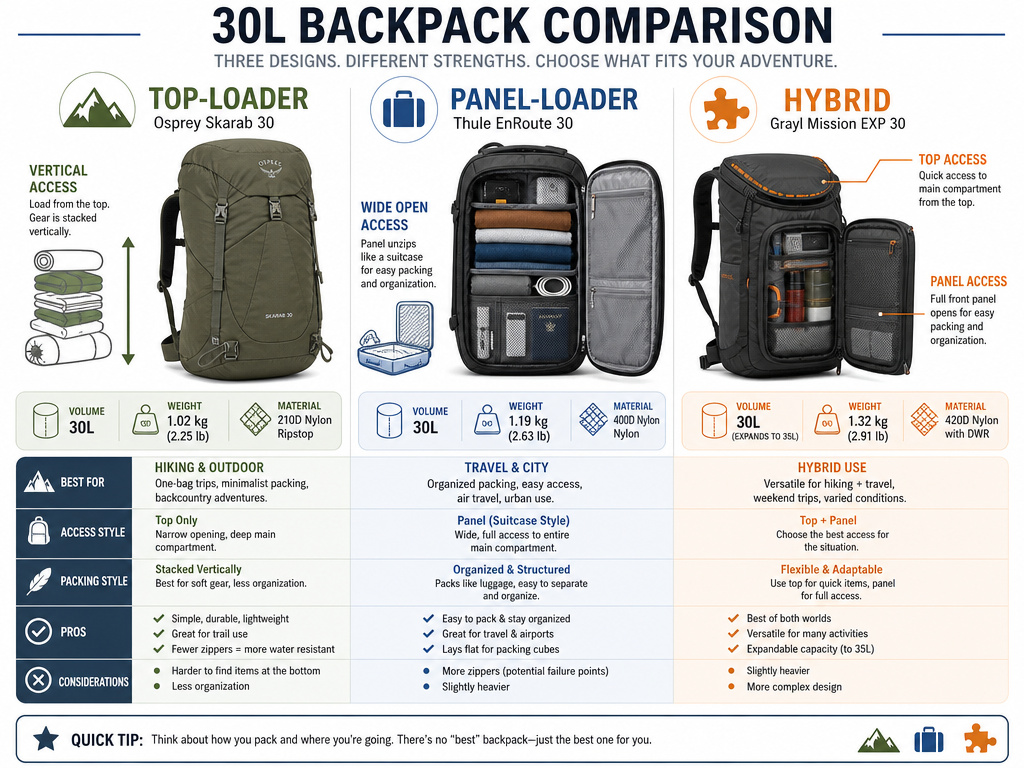
You have the specs. You know your torso. Now, which bag actually works?
Look past the color and the brand logo. The decision comes down to three things: access, comfort, and mission.
Access: How do you get your stuff out? – Top-loader (Osprey Skarab): Great for hiking. Gear goes in bottom to top, weight stays centered. Terrible for travel, you have to unpack everything to reach your laptop at the bottom. – Panel-loader (Thule EnRoute): The front or back unzips like a suitcase. Perfect for travel and work. You can see and reach everything instantly. Can be less stable for scrambling on trails. – Hybrid (Grayl Mission EXP): Has both top and front access. Versatile, but often heavier and more complex.
Comfort: The harness is the interface between you and the load. – Padded shoulder straps should be at least 2 inches wide. – A hip belt on a 30L pack is for stability, not weight transfer. It should be lightly padded and removable if you don’t need it. – Look for a ventilated back panel if you sweat. The Osprey AirScape panel uses a trampoline mesh to create an air channel.
Mission: Be brutally honest. – Is this for hiking? Prioritize a hydration sleeve, trekking pole attachments, and a simple, durable build like the Osprey Skarab. – Is this for travel and work? Prioritize a dedicated laptop sleeve, luggage pass-through, and professional looks like the Thule EnRoute. – Is this for edgy, urban carry? Look for modular attachment points (MOLLE/PALS) and clean, technical aesthetics like the Grayl Mission EXP.
TL;DR: For most people doing most things, day hikes, weekend trips, commuting, a 30L panel-loading backpack is the default. It’s the Swiss Army knife of bags. If your life leans hard toward one activity, specialize.
Frequently Asked Questions
Is a 30L backpack big enough for a 3-day trip?
It depends on your packing style and climate. For a summer weekend with minimal toiletries and no bulky shoes, yes. You can fit 3-4 lightweight outfits, a small toiletry kit, and a packable jacket. For a winter trip with a heavy sweater and boots, no. You’d need to wear the bulky items on the plane. A 40-liter backpack is a safer choice for multi-season, multi-day travel.
Can a 30L backpack be a personal item?
Sometimes, but it’s a gamble. Most 30L packs exceed the strict dimensions (often 18x14x8 inches) used by budget airlines for their free personal item. If the pack is soft-sided and you don’t fill it completely, you can often squeeze it into the sizer. For guaranteed compliance, look for a pack marketed specifically as a “personal item” or “under-seat bag,” which are typically 25-28 liters.
How much weight can a 30L backpack hold?
The pack’s construction, not its volume, determines weight capacity. A lightweight hiking pack like the Osprey Skarab has a “load range” of 5-25 lbs. A travel pack with a framesheet, like the Thule EnRoute, can handle 30+ lbs comfortably. Exceeding the manufacturer’s recommended load strains seams and zippers and makes the pack carry poorly. Distribute weight close to your back.
What’s the difference between a 30L and 50L backpack?
Twenty liters of space. In practical terms, a 50-liter backpack allows you to carry a full overnight system, tent, sleeping bag, pad, stove, food, and water, for multi-day backpacking. A 30L bag cannot hold a standard sleeping bag inside its main compartment. The 50L pack is also taller and heavier, often requiring a robust internal frame and a load-bearing hip belt.
Are 30L backpacks allowed as carry-ons?
On most full-service airlines, yes. The common carry-on dimension limit is 22 inches tall. Many 30L packs are designed to be 20-21 inches tall for this reason. Always verify your specific airline’s rules and remember that a fully packed bag will be deeper than its listed dimensions. When in doubt, you can usually keep your backpack on the plane as your carry-on item.
The Bottom Line
A 30-liter backpack isn’t a size. It’s a category with a huge range of shapes inside it. The Thule EnRoute, Osprey Skarab, and Grayl Mission EXP all prove that. Your job is to ignore the volume label and focus on the three numbers that matter: height, width, depth.
Match those numbers to your airline’s sizer bin and your own torso length. Choose the access style that fits how you actually rummage for your gear. The right 30L bag disappears on your back and holds exactly what you need. The wrong one is a constant, nagging compromise.
Measure your torso. Read the spec sheet. Then go pack it.